Altinity.Cloud Demo Environments
Altinity provides a number of sample databases and ClickHouse® clusters for experimenting with various ClickHouse features.
The Antalya Playground on Altinity.Cloud
The Antalya Playground lets you use hybrid tables that let you query ClickHouse MergeTree and shared Iceberg tables to deliver cheap, scalable real-time analytics.
When you log in to the system with the userid/password combination of demo/demo, you’ll see this panel:
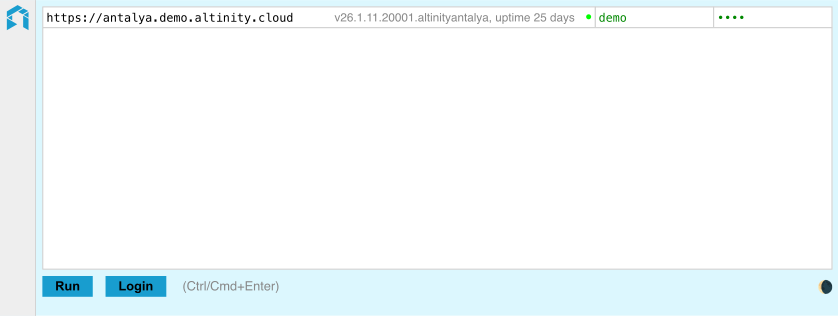
Figure 1 - The initial panel of the Antalya Playground
There are several things to notice in Figure 1 above:
- If you click the Altinity Logo in the upper left corner, it will display the databases and tables in the system once you’re logged in.
- The address bar lets you know the URL of the playground server and the version of Altinity Antalya it is running.
- The user
demois logged in. - The main attraction, of course, is the text box where you can execute SQL queries.
- The Run button beneath the text box executes your query. As noted on the screen, you can also type Ctrl/Cmd+Enter to run the command without clicking on the button.
- The icon on the right side beneath the text box toggles the display between light mode and dark mode.
Here are the results of a sample query:
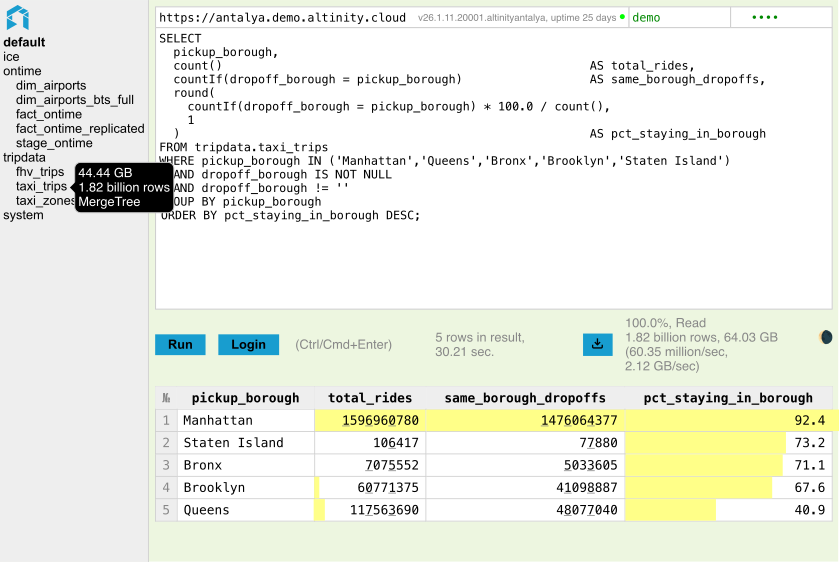
Figure 2 - A query result in the Antalya Playground
This query looks at all taxi rides where the rider was picked up and dropped off in the same borough, sorted by the percentage of all rides that started in that region. The usual query performance statistics appear between the text box and the results area. For numeric results, the yellow shading in the background provides visual cues to the size of the value.
In Figure 2 we have also clicked the Altinity Logo in the upper left to display all the databases in the system. The query above was in the tripdata.taxi_trips table; hovering over a table’s name shows the size of the table, the number of rows, and its engine.
You can download the results in a variety of data formats by clicking on the  button. Select a data format from the dropdown list and click Download:

Figure 3 - Downloading query results
Sample queries on the different tables are in the Datasets section that follows.
Datasets
The Antalya Playground is preloaded with two common databases: Tripdata and OnTime.
In this section we’ll look at a number of interesting queries you can run against the data in the playground. The query results will be displayed in the playground as shown in Figure 2 above. For this page, however, we’ll download the results as a markdown table as shown in Figure 3 and use it to display the results.
Tripdata
The Tripdata dataset contains records of taxi and for-hire vehicle rides in New York City from 2009 to 2025. The original Parquet files are available through the Taxi and Livery Commission's website.
Tables in the Antalya playground include:
tripdata.fhv_trips- Trips from for-hire vehicles and rideshare services starting in 2015tripdata.taxi_trips- Trips for yellow and green taxis starting in 2014tripdata.taxi_zones- A table that maps alocation_idto a zone name, borough, and subregion. As an example, the location261maps to the zoneWorld Trade Center, which is in themanhattan_below_60subregion ofManhattan. Useful for joins.
Here are some interesting queries against this data:
Trips that started and ended in the same borough
Here’s a query that looks at each of the five boroughs (Bronx, Brooklyn, Manhattan, Queens, and Staten Island) for analytics on trips that started and ended in the same borough.
Here’s the query:
SELECT
  pickup_borough,
  count()                                                    AS total_rides,
  countIf(dropoff_borough = pickup_borough)                  AS same_borough_dropoffs,
  round(
    countIf(dropoff_borough = pickup_borough) * 100.0 / count(),
    1
  )                                                          AS pct_staying_in_borough
FROM tripdata.taxi_trips
WHERE pickup_borough IN ('Manhattan','Queens','Bronx','Brooklyn','Staten Island')
  AND dropoff_borough IS NOT NULL
  AND dropoff_borough != ''
GROUP BY pickup_borough
ORDER BY pct_staying_in_borough DESC;
And the results:
| pickup_borough | total_rides | same_borough_dropoffs | pct_staying_in_borough |
|---|---|---|---|
| Manhattan | 1596960780 | 1476064377 | 92.4 |
| Staten Island | 106417 | 77880 | 73.2 |
| Bronx | 7075552 | 5033605 | 71.1 |
| Brooklyn | 60771375 | 41098887 | 67.6 |
| Queens | 117563690 | 48077040 | 40.9 |
Most people in Manhattan stayed in Manhattan; on the other hand, more than half the people picked up in Queens went elsewhere (the LaGuardia and JFK airports are in Queens, so lots of people go from the airport to some other borough).
Changing the query to get rideshare data from the fhv_trips table (just change the line above to FROM tripdata.fhv_trips), we get different results:
| pickup_borough | total_rides | same_borough_dropoffs | pct_staying_in_borough |
|---|---|---|---|
| Staten Island | 17813284 | 15660329 | 87.9 |
| Bronx | 154618369 | 119469960 | 77.3 |
| Brooklyn | 360239134 | 276326236 | 76.7 |
| Manhattan | 547917981 | 413570842 | 75.5 |
| Queens | 241775840 | 165807747 | 68.6 |
Far more Uber and Lyft trips stayed in the same borough, suggesting that people use Uber and Lyft for shorter trips. (Checking that is left as an exercise to the reader.)
Taxi trips in July
This query shows how many taxi trips happened in the month of July through the dataset:
SELECT
  toStartOfMonth(pickup_datetime) AS month,
  count()                         AS trips
FROM tripdata.taxi_trips
WHERE toMonth(pickup_datetime) = 7
GROUP BY month
ORDER BY month;
The results show a dramatic drop-off at the peak of the pandemic, as you’d expect:
| month | trips |
|---|---|
| 2009-07-01 | 13626103 |
| 2010-07-01 | 14656519 |
| 2011-07-01 | 14742561 |
| 2012-07-01 | 14379307 |
| 2013-07-01 | 13823840 |
| 2014-07-01 | 14378246 |
| 2015-07-01 | 13101337 |
| 2016-07-01 | 11626590 |
| 2017-07-01 | 9503269 |
| 2018-07-01 | 8535341 |
| 2019-07-01 | 6781088 |
| 2020-07-01 | 872692 |
| 2021-07-01 | 2905788 |
| 2022-07-01 | 3238567 |
| 2023-07-01 | 2968439 |
Let’s try a query that combines the taxi data and the ridesharing data:
SELECT
  month,
  taxi_trips,
  fhv_trips,
  taxi_trips + fhv_trips AS total_trips
FROM (
  SELECT
    toStartOfMonth(pickup_datetime) AS month,
    count()                         AS taxi_trips
  FROM tripdata.taxi_trips
  WHERE toMonth(pickup_datetime) = 7
  GROUP BY month
) t
JOIN (
  SELECT
    toStartOfMonth(pickup_datetime) AS month,
    count()                         AS fhv_trips
  FROM tripdata.fhv_trips
  WHERE toMonth(pickup_datetime) = 7
  GROUP BY month
) f USING (month)
ORDER BY month;
The results are similar, a major dropoff during the pandemic:
| month | taxi_trips | fhv_trips | total_trips |
|---|---|---|---|
| 2015-07-01 | 13101337 | 4384986 | 17486323 |
| 2016-07-01 | 11626590 | 10977358 | 22603948 |
| 2017-07-01 | 9503269 | 15672674 | 25175943 |
| 2018-07-01 | 8535341 | 21599714 | 30135055 |
| 2019-07-01 | 6781088 | 22251100 | 29032188 |
| 2020-07-01 | 872692 | 11085943 | 11958635 |
| 2021-07-01 | 2905788 | 16267188 | 19172976 |
| 2022-07-01 | 3238567 | 18624198 | 21862765 |
| 2023-07-01 | 2968439 | 20502974 | 23471413 |
Most popular hour by day of the week
Looking at the seven days of the week, which is the most popular hour for people to be picked up?
SELECT
  ['Monday','Tuesday','Wednesday','Thursday','Friday','Saturday','Sunday'][dow] AS day_name,
  hour,
  trips
FROM (
  SELECT
    toDayOfWeek(pickup_datetime) AS dow,
    toHour(pickup_datetime)      AS hour,
    count()                      AS trips,
    row_number() OVER (
      PARTITION BY toDayOfWeek(pickup_datetime)
      ORDER BY count() DESC
    )                            AS rn
  FROM tripdata.taxi_trips
  GROUP BY dow, hour
)
WHERE rn = 1
ORDER BY dow;
Here are the results:
| day_name | hour | trips |
|---|---|---|
| Monday | 18 | 15849481 |
| Tuesday | 18 | 16925811 |
| Wednesday | 19 | 17347673 |
| Thursday | 19 | 17617635 |
| Friday | 19 | 17890364 |
| Saturday | 19 | 16587343 |
| Sunday | 0 | 15245544 |
People are getting into taxis at 6:00 or 7:00 pm every day except Sunday, when the highest traffic seems to be Saturday night revelers hailing a cab after midnight.
For ridesharing services (use FROM taxidata.fhv_trips in the query above), the data is a little different:
| day_name | hour | trips |
|---|---|---|
| Monday | 8 | 13742138 |
| Tuesday | 8 | 14652655 |
| Wednesday | 18 | 14990988 |
| Thursday | 18 | 15685006 |
| Friday | 19 | 17442085 |
| Saturday | 19 | 17574739 |
| Sunday | 0 | 15792141 |
Uber and Lyft are more popular on Monday and Tuesday mornings, but as with regular taxis, the night hawks are using ridesharing services after midnight Saturday.
The impact of ridesharing services
Uber launched in NYC in 2011, and Lyft launched in 2014. Here’s a look at the percentage of rides on ridesharing services versus traditional taxis since 2015:
WITH taxi AS (
  SELECT
    toYear(pickup_datetime)        AS year,
    toStartOfMonth(pickup_datetime) AS month,
    count()                         AS trips
  FROM tripdata.taxi_trips
  WHERE pickup_datetime IS NOT NULL
  GROUP BY year, month
),
fhv AS (
  SELECT
    toYear(pickup_datetime)        AS year,
    toStartOfMonth(pickup_datetime) AS month,
    count()                         AS trips
  FROM tripdata.fhv_trips
  WHERE pickup_datetime IS NOT NULL
  GROUP BY year, month
),
taxi_annual AS (
  SELECT
    year,
    round(avg(trips), 0)  AS avg_monthly_taxi_trips,
    sum(trips)            AS total_taxi_trips
  FROM taxi
  GROUP BY year
),
fhv_annual AS (
  SELECT
    year,
    round(avg(trips), 0)  AS avg_monthly_fhv_trips,
    sum(trips)            AS total_fhv_trips
  FROM fhv
  GROUP BY year
)
SELECT
  t.year,
  t.avg_monthly_taxi_trips,
  f.avg_monthly_fhv_trips,
  t.total_taxi_trips + f.total_fhv_trips        AS total_trips,
  round(f.total_fhv_trips * 100.0 /
    (t.total_taxi_trips + f.total_fhv_trips), 2) AS pct_fhv
FROM taxi_annual t
JOIN fhv_annual f USING (year)
ORDER BY t.year;
The results are dramatic: In 2015, as ridesharing services were starting to take hold, just over a quarter of rides were with Uber and Lyft. That percentage grew steadily; since 2020, Uber and Lyft have had roughly 85% of the market.
| year | avg_monthly_taxi_trips | avg_monthly_fhv_trips | total_trips | pct_fhv |
|---|---|---|---|---|
| 2015 | 13772750 | 5282378 | 228661529 | 27.72 |
| 2016 | 12293112 | 11009507 | 279631429 | 47.25 |
| 2017 | 10436441 | 16025796 | 317546849 | 60.56 |
| 2018 | 9314153 | 21739563 | 372644592 | 70.01 |
| 2019 | 7574844 | 23157628 | 368789663 | 75.35 |
| 2020 | 2198619 | 13187945 | 184638768 | 85.71 |
| 2021 | 2664393 | 15783493 | 221374629 | 85.56 |
| 2022 | 3374668 | 18910646 | 267423763 | 84.86 |
| 2023 | 3258099 | 20695722 | 287445852 | 86.4 |
| 2024 | 1510582 | 20954046 | 23975210 | 87.4 |
OnTime
The OnTime dataset has records of airline on-time performance of domestic US flights from 1987 to 2025. It is provided by the Bureau of Transportation Statistics.
Tables in the Antalya playground include:
ontime.fact_ontimeandontime.fact_online_replicated- The main flight data, including the date and time, carrier, origin airport, destination airport, and how many minutes late (if any) a flight arrived. The engines of the two databases areMergeTreeandReplicatedMergeTree, as you would expect, but the data is the same.ontime.dim_airportsandontime.dim_airports_bts_full- Complete airport metadata, such as airport name, country code, latitude, and longitude.bts_fullis an unabridged dataset of all airports, including airports that are now closed.
Here are some interesting queries against this data.
Least punctual airlines
Here’s a query to find the 15 airlines with the worst on-time performance since 2018:
WITH carrier_names AS (
  SELECT
    Carrier,
    multiIf(
      Carrier = 'AA', 'American Airlines',
      Carrier = 'AS', 'Alaska Airlines',
      Carrier = 'B6', 'JetBlue Airways',
      Carrier = 'CO', 'Continental Airlines',
      Carrier = 'DL', 'Delta Air Lines',
      Carrier = 'EV', 'ExpressJet Airlines',
      Carrier = 'F9', 'Frontier Airlines',
      Carrier = 'FL', 'AirTran Airways',
      Carrier = 'G4', 'Allegiant Air',
      Carrier = 'HA', 'Hawaiian Airlines',
      Carrier = 'HP', 'America West Airlines',
      Carrier = 'MQ', 'Envoy Air (American Eagle)',
      Carrier = 'NK', 'Spirit Airlines',
      Carrier = 'NW', 'Northwest Airlines',
      Carrier = 'OH', 'PSA Airlines',
      Carrier = 'OO', 'SkyWest Airlines',
      Carrier = 'QX', 'Horizon Air',
      Carrier = 'TW', 'Trans World Airlines',
      Carrier = 'UA', 'United Airlines',
      Carrier = 'US', 'US Airways',
      Carrier = 'VX', 'Virgin America',
      Carrier = 'WN', 'Southwest Airlines',
      Carrier = 'YV', 'Mesa Airlines',
      Carrier = 'YX', 'Republic Airways',
      Carrier
    ) AS carrier_name
  FROM ontime.fact_ontime
  GROUP BY Carrier
)
SELECT
  cn.carrier_name,
  count()                          AS flights,
  round(avg(ArrDelayMinutes), 2)   AS avg_arr_delay_mins,
  concat(toDecimalString(
    round(countIf(ArrDel15 = 1) * 100.0 / count(), 2),
  2), '%')                         AS pct_late
FROM ontime.fact_ontime f
JOIN carrier_names cn USING (Carrier)
WHERE Cancelled = 0
  AND Year >= 2018
GROUP BY cn.carrier_name
ORDER BY avg_arr_delay_mins DESC
LIMIT 15;
Our multiIf clause replaces the airline carrier code (B6) with the name of the airline (JetBlue Airlines). It makes the query longer, but the results are much more legible.
Here are our results, sorted by how many minutes late an airline’s flights are on average:
| carrier_name | flights | avg_arr_delay_mins | pct_late |
|---|---|---|---|
| JetBlue Airways | 1923885 | 21.46 | 26.68% |
| Frontier Airlines | 1195804 | 21.4 | 27.03% |
| Allegiant Air | 869378 | 19.92 | 24.65% |
| ExpressJet Airlines | 373917 | 18.47 | 21.35% |
| American Airlines | 6787795 | 17.61 | 21.54% |
| Mesa Airlines | 824697 | 16.46 | 19.27% |
| Spirit Airlines | 1626039 | 16.28 | 21.87% |
| PSA Airlines | 1808876 | 15.8 | 19.60% |
| SkyWest Airlines | 5845849 | 14.99 | 17.26% |
| United Airlines | 4836788 | 14.82 | 19.41% |
| Envoy Air (American Eagle) | 2087284 | 12.65 | 18.68% |
| Republic Airways | 2383285 | 11.99 | 16.44% |
| Virgin America | 17237 | 11.95 | 19.96% |
| 9E | 1579112 | 11.5 | 14.02% |
| Delta Air Lines | 7101668 | 11.48 | 15.22% |
As you can see, JetBlue, Frontier, and Allegiant are all late roughly a quarter of the time, with those flights averaging 20+ minutes late. (Carrier code 9E is Endeavor Air, btw.)
Late arriving aircraft cascade effect
This query takes a look at how late aircraft impact flights through the day. A given airplane will likely make several flights a day, particularly on regional routes. If any of those flights is late, it affects every subsequent flight that plane is scheduled to fly. Here’s the query:
SELECT
  intDiv(CRSDepTime, 100)                        AS scheduled_hour,
  round(avg(DepDelayMinutes), 2)                  AS avg_dep_delay,
  round(countIf(LateAircraftDelay > 0) * 100.0 /
    count(), 2)                                   AS pct_flights_with_late_aircraft,
  count()                                         AS flights
FROM ontime.fact_ontime
WHERE Cancelled = 0
  AND DepDelayMinutes > 0
  AND CRSDepTime IS NOT NULL
  AND intDiv(CRSDepTime, 100) BETWEEN 5 AND 23
GROUP BY scheduled_hour
ORDER BY scheduled_hour;
As you would expect, the average flight delay and the percentage of flights with late aircraft increase through the day, as one delay likely leads to another:
| scheduled_hour | avg_dep_delay | pct_flights_with_late_aircraft | flights |
|---|---|---|---|
| 5 | 34.21 | 1.59 | 466587 |
| 6 | 24 | 1.3 | 3040805 |
| 7 | 22.94 | 2.95 | 3884887 |
| 8 | 22.22 | 5.88 | 4765492 |
| 9 | 22.7 | 9.4 | 4687160 |
| 10 | 23.9 | 13.08 | 4904421 |
| 11 | 24.47 | 14.22 | 5412825 |
| 12 | 25.51 | 15.06 | 5633853 |
| 13 | 26.5 | 15.87 | 5992125 |
| 14 | 28.22 | 17.76 | 5767062 |
| 15 | 28.79 | 17.84 | 6266391 |
| 16 | 30.34 | 19.54 | 6292767 |
| 17 | 32.27 | 20.06 | 7197384 |
| 18 | 33.68 | 21.63 | 6597901 |
| 19 | 35.29 | 23.19 | 5936959 |
| 20 | 34.65 | 21.49 | 4980095 |
| 21 | 33.33 | 21.11 | 3307529 |
| 22 | 33.24 | 20.04 | 1704358 |
| 23 | 28.74 | 14.31 | 644409 |
The late aircraft effect peaks around 7:00 pm, then declines. The number of flights per hour are at their highest from 3:00 pm to 6:00 pm; as the number of flights goes down, the impact of late aircraft starts to subside.
Types of delays
The fact_ontime table defines several different types of delays:
- Carrier delays - Anything caused by the airline, including maintenance, cleaning, or a late-arriving crew.
- Weather - Self-explanatory
- NAS (National Air System) - Anything controlled by the FAA, including ground stops and runway changes
- Security - Screening issues from the TSA, very rare
- Late aircraft - The incoming aircraft arrived late
Here’s a query that finds the various kinds of delays by the 15 airlines with the highest average carrier delay, starting with our multiIf statement:
SELECT
  multiIf(
    Carrier = 'AA', 'American Airlines',
    Carrier = 'AS', 'Alaska Airlines',
    Carrier = 'B6', 'JetBlue Airways',
    Carrier = 'CO', 'Continental Airlines',
    Carrier = 'DH', 'Atlantic Coast Airlines / Independence Air',
    Carrier = 'DL', 'Delta Air Lines',
    Carrier = 'EV', 'ExpressJet Airlines',
    Carrier = 'F9', 'Frontier Airlines',
    Carrier = 'FL', 'AirTran Airways',
    Carrier = 'G4', 'Allegiant Air',
    Carrier = 'HA', 'Hawaiian Airlines',
    Carrier = 'HP', 'America West Airlines',
    Carrier = 'MQ', 'Envoy Air (American Eagle)',
    Carrier = 'NK', 'Spirit Airlines',
    Carrier = 'NW', 'Northwest Airlines',
    Carrier = 'OH', 'PSA Airlines',
    Carrier = 'OO', 'SkyWest Airlines',
    Carrier = 'QX', 'Horizon Air',
    Carrier = 'TW', 'Trans World Airlines',
    Carrier = 'UA', 'United Airlines',
    Carrier = 'US', 'US Airways',
    Carrier = 'VX', 'Virgin America',
    Carrier = 'WN', 'Southwest Airlines',
    Carrier = 'XE', 'ExpressJet Airlines',
    Carrier = 'YV', 'Mesa Airlines',
    Carrier = 'YX', 'Republic Airways',
    Carrier
  )                                  AS carrier_name,
  round(avg(CarrierDelay), 2)        AS avg_carrier_delay,
  round(avg(WeatherDelay), 2)        AS avg_weather_delay,
  round(avg(NASDelay), 2)            AS avg_nas_delay,
  round(avg(SecurityDelay), 2)       AS avg_security_delay,
  round(avg(LateAircraftDelay), 2)   AS avg_late_aircraft_delay
FROM ontime.fact_ontime
WHERE Cancelled = 0
  AND ArrDelayMinutes > 0
  AND Year >= 2018
GROUP BY carrier_name
ORDER BY avg_carrier_delay DESC
LIMIT 15;
Here are the results:
| carrier_name | avg_carrier_delay | avg_weather_delay | avg_nas_delay | avg_security_delay | avg_late_aircraft_delay |
|---|---|---|---|---|---|
| SkyWest Airlines | 39.03 | 10.26 | 10.74 | 0.12 | 21.28 |
| Delta Air Lines | 31.09 | 3.92 | 14.59 | 0.08 | 19.77 |
| Mesa Airlines | 29.48 | 7.13 | 11.74 | 0.1 | 31.77 |
| JetBlue Airways | 29.08 | 2.07 | 15.68 | 0.16 | 29.67 |
| Hawaiian Airlines | 27.28 | 1.55 | 1.28 | 0.24 | 16.01 |
| American Airlines | 26.91 | 4.02 | 12.5 | 0.15 | 33.23 |
| ExpressJet Airlines | 26.63 | 3.25 | 27.56 | 0 | 24.64 |
| Allegiant Air | 24.83 | 6.45 | 13.79 | 0.26 | 30.88 |
| 9E | 24.02 | 5.89 | 19 | 0.03 | 28.27 |
| Frontier Airlines | 22.01 | 1.7 | 15.05 | 0 | 36.65 |
| PSA Airlines | 21.7 | 5.43 | 11.35 | 0.14 | 36.69 |
| United Airlines | 20.26 | 3.85 | 18.99 | 0.01 | 28.16 |
| Horizon Air | 18.63 | 2.8 | 8.79 | 0.16 | 20.32 |
| Spirit Airlines | 18.34 | 2.55 | 28.81 | 0.45 | 19.73 |
| Republic Airways | 17.43 | 3.98 | 22.27 | 0.06 | 24.02 |
That data is somewhat misleading, however; we’re showing the average carrier delay. Delta Air Lines has an average carrier delay of more than half an hour, which doesn’t sound good. But how often does a carrier delay happen? If an airline’s carrier delay is long, but that airline hardly ever has a carrier delay, that’s good to know. On the other hand, if an airline has a short average carrier delay but carrier delays happen all the time, that’s also useful information.
Here’s a query that looks at carrier delays, calculating an expected carrier delay based on the average carrier delay and how often a carrier delay happens:
SELECT
  carrier_name,
  round(avg(CarrierDelay), 1)                                AS avg_carrier_delay,
  round(countIf(CarrierDelay > 0) * 100.0 / count(), 1)     AS pct_carrier_delay,
  round(
    (countIf(CarrierDelay > 0) * 1.0 / count())
    * avg(CarrierDelay)
  , 2)                                                       AS expected_carrier_delay_per_flight
FROM (
  SELECT
    multiIf(
      Carrier = 'AA', 'American Airlines',
      Carrier = 'AS', 'Alaska Airlines',
      Carrier = 'B6', 'JetBlue Airways',
      Carrier = 'CO', 'Continental Airlines',
      Carrier = 'DH', 'Atlantic Coast Airlines / Independence Air',
      Carrier = 'DL', 'Delta Air Lines',
      Carrier = 'EV', 'ExpressJet Airlines',
      Carrier = 'F9', 'Frontier Airlines',
      Carrier = 'FL', 'AirTran Airways',
      Carrier = 'G4', 'Allegiant Air',
      Carrier = 'HA', 'Hawaiian Airlines',
      Carrier = 'HP', 'America West Airlines',
      Carrier = 'MQ', 'Envoy Air (American Eagle)',
      Carrier = 'NK', 'Spirit Airlines',
      Carrier = 'NW', 'Northwest Airlines',
      Carrier = 'OH', 'PSA Airlines',
      Carrier = 'OO', 'SkyWest Airlines',
      Carrier = 'QX', 'Horizon Air',
      Carrier = 'TW', 'Trans World Airlines',
      Carrier = 'UA', 'United Airlines',
      Carrier = 'US', 'US Airways',
      Carrier = 'VX', 'Virgin America',
      Carrier = 'WN', 'Southwest Airlines',
      Carrier = 'XE', 'ExpressJet Airlines',
      Carrier = 'YV', 'Mesa Airlines',
      Carrier = 'YX', 'Republic Airways',
      Carrier
    ) AS carrier_name,
    CarrierDelay
  FROM ontime.fact_ontime
  WHERE Cancelled = 0
)
GROUP BY carrier_name
ORDER BY expected_carrier_delay_per_flight DESC
LIMIT 15;
Here are the results:
| carrier_name | avg_carrier_delay | pct_carrier_delay | expected_carrier_delay_per_flight |
|---|---|---|---|
| JetBlue Airways | 22.2 | 15.6 | 3.47 |
| Allegiant Air | 24.8 | 11.1 | 2.76 |
| Hawaiian Airlines | 28.3 | 9.1 | 2.57 |
| Mesa Airlines | 27.4 | 9 | 2.45 |
| Frontier Airlines | 18.1 | 12.9 | 2.34 |
| ExpressJet Airlines | 20.6 | 10.5 | 2.16 |
| PSA Airlines | 21.5 | 10 | 2.15 |
| SkyWest Airlines | 26.6 | 7.9 | 2.1 |
| Spirit Airlines | 17.1 | 10.2 | 1.75 |
| American Airlines | 21.7 | 6.4 | 1.39 |
| 9E | 21.9 | 6.2 | 1.36 |
| Horizon Air | 18.6 | 6.8 | 1.27 |
| Southwest Airlines | 13.8 | 8.5 | 1.18 |
| Envoy Air (American Eagle) | 15 | 7.7 | 1.15 |
| Republic Airways | 17.4 | 6.3 | 1.1 |
With this query, Delta Air Lines and United Airlines are no longer in the results, with Southwest Airlines and Envoy air now included.
The Altinity Stable® Playground on Altinity.Cloud
The Altinity Stable Playground lets you run SQL queries against several sample databases. Altinity Stable Builds are 100% compatible with ClickHouse with robust upgrade and 3 years of support.
When you log in to the system with the userid/password combination of demo/demo, you’ll see this panel:
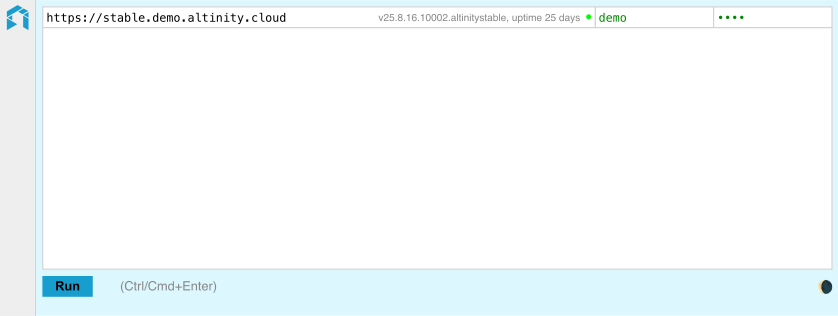
Figure 4 - The initial panel of the Altinity Stable Playground
There are several things to notice in Figure 4 above:
- If you click the Altinity Logo in the upper left corner, it will display the databases and tables in the system once you’re logged in.
- The address bar lets you know the URL of the playground server and the version of Altinity Antalya it is running.
- The user
demois logged in. - The main attraction, of course, is the text box where you can execute SQL queries.
- The Run button beneath the text box executes your query. As noted on the screen, you can also type Ctrl/Cmd+Enter to run the command without clicking on the button.
- The icon on the right side beneath the text box toggles the display between light mode and dark mode.
Here are the results of a sample query:
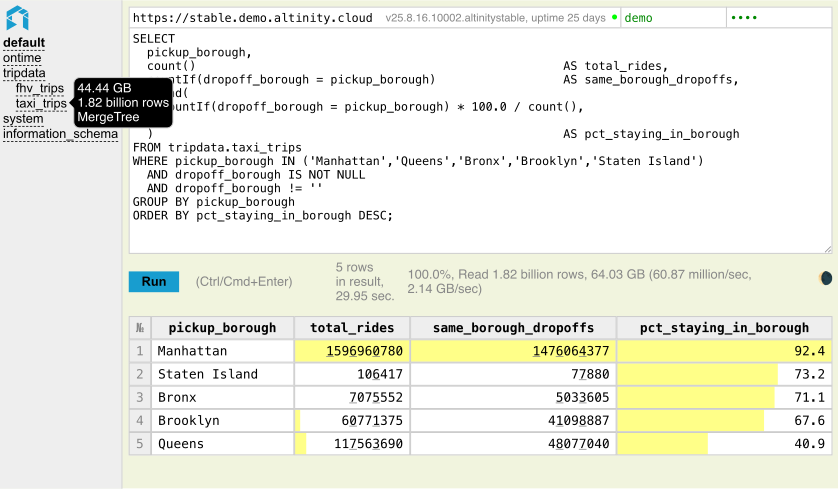
Figure 5 - A query result in the Altinity Stable Playground
This query looks at all taxi rides where the rider was picked up and dropped off in the same borough, sorted by the percentage of all rides that started in that region. Most people in Manhattan stayed in Manhattan; on the other hand, more than half the people picked up in Queens went elsewhere (the LaGuardia and JFK airports are in Queens). The usual query performance statistics appear between the text box and the results area. For numeric results, the yellow shading in the background provides visual cues to the size of the value.
In Figure 5 we have also clicked the Altinity Logo in the upper left to display all the databases in the system. The query above was in the tripdata.taxi_trips table; hovering over the table’s name shows the size of the table, the number of rows, and its engine.
If you’d like to run this query yourself, here it is:
SELECT
  pickup_borough,
  count()                                                    AS total_rides,
  countIf(dropoff_borough = pickup_borough)                  AS same_borough_dropoffs,
  round(
    countIf(dropoff_borough = pickup_borough) * 100.0 / count(),
    1
  )                                                          AS pct_staying_in_borough
FROM tripdata.taxi_trips
WHERE pickup_borough IN ('Manhattan','Queens','Bronx','Brooklyn','Staten Island')
  AND dropoff_borough IS NOT NULL
  AND dropoff_borough != ''
GROUP BY pickup_borough
ORDER BY pct_staying_in_borough DESC;
You can run queries such as DESCRIBE TABLE tripdata.taxi_trips for information about the structure of the databases.
Datasets
The Altinity Stable Playground is preloaded with two common databases.
OnTime
The OnTime dataset has records of airline on-time performance of domestic US flights from 1987 to 2025.
Tables in the public playground include:
ontime.fact_ontime(main flight data)ontime.dim_airports(dimension table for active airports)ontime.dim_airports_bts_full(dimension table for all historical airports)
Tripdata
The Tripdata dataset contains records of taxi and for-hire vehicle rides in New York City from 2009 to 2025. Tables in the public playground include:
tripdata.fhv_trips(trips from for-hire vehicles/rideshare starting in 2015)tripdata.taxi_trips(trips for yellow and green cabs)tripdata.taxi_zones(dimension table for taxi zone codes)
The Altinity.Cloud demo environment
Altinity has created several guides in the Integrations section of the Altinity Documentation site as well as various blog posts posted in the Altinity Resources Page. To accompany these guides, Altinity has created a public ClickHouse® database hosted through Altinity.Cloud. Our goal is to help new users experience ClickHouse and to help experienced ClickHouse administrators test the connections between applications and ClickHouse.
Database Details
The Altinity.Cloud Demo database has the following connection information:
- URL:
github.demo.altinity.cloud - HTTP Protocol:
HTTPS - HTTPS Port:
8443 - ClickHouse Client Port:
9440 - Database:
default - Username:
demo - Password:
demo
Altinity.Cloud Demo Database Connection Examples
The following examples provide a quick demonstration on how to connect specific interfaces and applications to the Altinity.Cloud Demo ClickHouse cluster.
ClickHouse Play
ClickHouse lets you run queries directly using a simple HTML interface:
https://github.demo.altinity.cloud:8443/play
ClickHouse Client
To connect to the Altinity.Cloud Demo database with the native ClickHouse client, use the following command:
clickhouse-client --host github.demo.altinity.cloud --user=demo --password=demo --port=9440 --secure
DBeaver and JDBC Connectors
For applications like DBeaver that use JDBC drivers to connect to database, use the following settings:
- From the main menu, select Database->New Database Connection.
- From the Select your database screen, select ClickHouse.
- On the Main tab, set the following options:
- JDBC URL:
jdbc:clickhouse://github.demo.altinity.cloud:8443/default(DBeaver populates this by default based on the other settings). - Host:
github.demo.altinity.cloud - Port:
8443 - Database/Schema:
default - Username:
demo - Password:
demo
- JDBC URL:
- On the Driver Properties tab, set ssl to
true. - Click Finish.
Grafana
For Grafana, see the Integrating Grafana with ClickHouse guide.
Available Test Data
The demo user is allowed to access the default database and table functions. You can run SHOW TABLES to list available tables. The main public datasets that are often used in examples are:
ontime
The ontime table is provided by the Bureau of Transportation Statistics. It is collected from Airline On-Time Performance Data. This information is based on flight data collected by US certified air carriers regarding departure and arrival times, flights cancelled, flights with delayed departure or arrival times, and other relevant data.
airports
The table airports is information on airports, including the name of the airport, city, latitude and longitude, and other relevant information. For the Altinity.Cloud Demo database, this is often joined with the ontime table. The information in this table is provided by OpenFlights.org, from their Airport database.
tripdata
The tripdata table is based on the New York City Taxi and Limousine Commission (TLC) Trip Record Data for Yellow Cab rides. This table contains information about rides starting and ending in New York City, including the date and time of pickups and dropoffs, the total amount of the fare, and other data. This was used as part of the article Tableau Tricks with ClickHouse.
github_events
The table github_events is a collection of all Github events between 2011 to 2020, comprising 3.1 billion records and 200 GB of data. This is provided from the GH Archive.